A caterer quotes ₹800 a plate for veg and ₹1,000 for non-veg, and the family budgets on those numbers. Then the bill arrives with plates nobody ate, a crockery charge, the counters, meals for the band and the drivers, and GST. The food was what was promised. The rate per plate wasn't the price.
The fix is to price catering the way the bill is built: plates × the rate, for each function, plus everything the rate leaves out, plus tax.
In this guide, we'll break down:
- what a per-plate rate usually covers, and what it often doesn't;
- seven checks to work out the real cost of wedding catering;
- a worked example for one 250-guest dinner, line by line;
- a caterer or a halwai: the two ways families pay for wedding food;
- warning signs in a catering quote.
It's for whoever is booking the food, for the wedding or for any function before it. For the whole wedding budget, see our wedding budget plan.
On this page
What a per-plate rate covers
A per-plate rate is the price of one guest's meal from the menu you agree. What else it holds differs from caterer to caterer, so ask which of these are in the rate, in writing:
- The menu itself: the starters, main course, breads, rice, desserts and drinks, item by item.
- Service staff: the waiters and the people at the buffet. Some caterers add them as one charge.
- Crockery and cutlery: plain plates may be in the rate, with ceramic or steel charged extra per plate.
- The buffet setup: tables, covers, heaters and lights over the food.
- Counters: a live chaat, tandoor or pasta counter is often priced apart.
- Water and soft drinks, and the welcome drink as guests arrive.
- Transport and gas, when the cooking happens at the venue.
- GST, when the quote says "plus taxes".
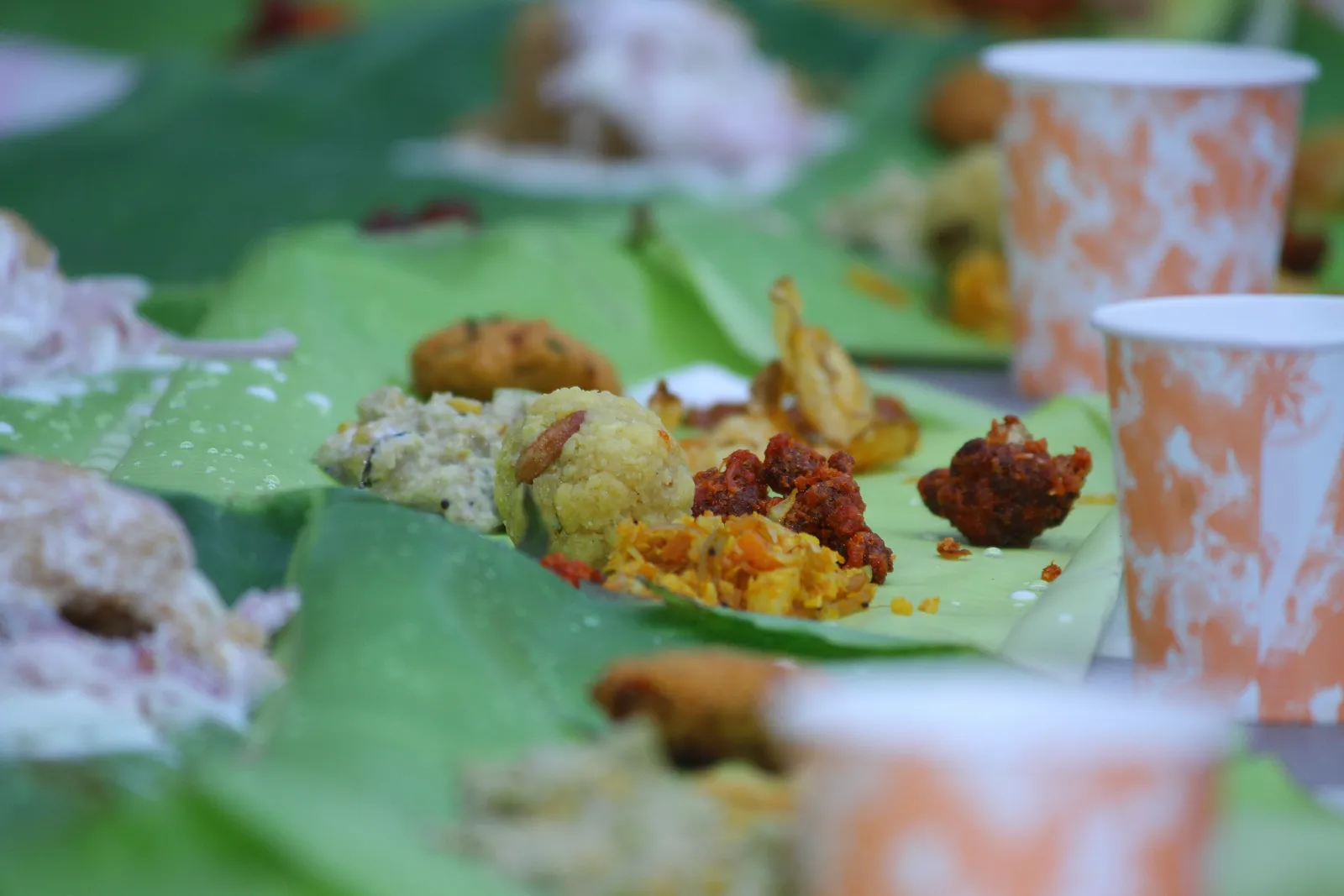 Photo: Rajeshkumaraswamy, CC BY-SA 4.0, via Wikimedia Commons
How to work out the cost of wedding catering, in seven checks
1. Count the plates for each function
Every function has its own guest list and its own menu, so price each one apart. A mehndi lunch isn't a wedding dinner.
Example: 250 guests at the wedding dinner and 120 at the mehndi lunch is 370 plates. Say the dinner is ₹900 a plate and the lunch ₹450. At the dinner rate for everyone, that's ₹3,33,000. Priced apart, it's 250 × ₹900 + 120 × ₹450 = ₹2,79,000: ₹54,000 less.
2. Price veg and non-veg apart
Non-veg plates usually cost more. Ask whether the caterer charges the non-veg rate for every guest, or counts veg and non-veg plates apart.
Example: say a caterer quotes ₹800 for veg and ₹1,000 for non-veg, and 100 of your 250 guests eat non-veg. Counted apart, that's 150 × ₹800 + 100 × ₹1,000 = ₹2,20,000. At the non-veg rate for all 250, it's ₹2,50,000.
3. Agree the minimum plates
Most caterers ask for a minimum: the number of plates you'll pay for even if fewer guests come. Give the count you're sure of, not the invited list, and ask what each plate above it costs.
Example: you commit to 250 plates at ₹800, and 220 guests come. You still pay for 250: ₹24,000 for 30 plates nobody ate. If 270 come and extra plates are ₹900, the 20 extra plates add ₹18,000.
4. Ask what the rate leaves out
Go through the list above with the caterer and write the answer next to each line. Anything left out comes back as a charge on the day.
Example: say the quote leaves out ceramic crockery at ₹50 a plate and charges ₹15,000 for service staff. For 250 guests, that's ₹12,500 + ₹15,000 = ₹27,500 more than the plate rates.
5. Price the counters apart
Live counters are priced per plate or as one charge for the evening. Ask which, and whether the count is every guest or only those who eat at it.
Example: a live chaat counter at ₹60 a plate, counted for all 250 guests, is 250 × ₹60 = ₹15,000.
6. Count the plates for staff and helpers
The band, the drivers, the photographer's team and the decorator's people eat too. Ask the caterer for a staff rate, and add these plates to the count.
Example: 20 plates for the band, drivers and photographers at a staff rate of ₹300 is ₹6,000. At the guest rate of ₹800, it would be ₹16,000.
7. Add GST and agree the advance
Ask whether each quote includes GST. Catering for a function is taxed at 5%, and so is a hall that rents with its own food. At a hotel that charged more than ₹7,500 a day for a room in the previous year, or chose to be taxed as one, it's 18%.
Example: a catering bill of ₹2,68,500 before tax is ₹2,68,500 + ₹13,425 = ₹2,81,925 with 5% GST. If the caterer asks for a quarter of it to block your date, that's ₹70,481.
Pay the advance and the balance by UPI, bank transfer or cheque, and keep the receipts. A vendor can't take ₹2,00,000 or more in cash from one person for one event: our wedding budget plan has the rule.
A worked example: one 250-guest wedding dinner
Here's the whole sum for one made-up dinner, using the rates from the checks above. They show the arithmetic. They aren't prices from any caterer, and yours will differ by city, season and menu.
| Head | Amount |
|---|---|
| Veg plates: 150 × ₹800 | ₹1,20,000 |
| Non-veg plates: 100 × ₹1,000 | ₹1,00,000 |
| Crockery upgrade: 250 × ₹50 | ₹12,500 |
| Service staff: one charge for the evening | ₹15,000 |
| Live chaat counter: 250 × ₹60 | ₹15,000 |
| Plates for the band, drivers and photographers: 20 × ₹300 | ₹6,000 |
| Subtotal | ₹2,68,500 |
| GST at 5% | ₹13,425 |
| Total | ₹2,81,925 |
| Per guest (₹2,81,925 ÷ 250) | ₹1,128 |
The plate rates were ₹800 and ₹1,000. The cost came to ₹1,128 a guest. That gap is what to plan for.
A caterer or a halwai
Families pay for wedding food in one of two ways, and many towns have both.
- A caterer, per plate. The caterer buys the raw material, cooks, serves and clears up. You compare one number per plate, and the caterer carries the risk of running short.
- A halwai, for the cooking. The halwai charges for cooking the menu, and the family buys the ration: the raw material, oil, ghee and gas, often from a list the halwai gives. Utensils, the tent and the serving staff are hired apart.
A halwai can cost less, but the family carries the shopping, the leftovers and the risk of running short. If you go this way, ask the halwai for the ration list in quantities for your guest count before you agree the charge, and price it before you decide.
Warning signs in a catering quote
- A rate with no menu attached. Two caterers' rates mean nothing until they quote for the same food.
- "Plus taxes" or "plus extras" with no list of what the extras are.
- No minimum written down, or extra plates charged "at actuals".
- No tasting before the advance. Ask for one; some caterers charge for it.
- The whole amount asked up front, or a large share in cash.
- The venue's rule left out. Some halls allow only their own caterer, or charge a fee for an outside one. Ask the venue before you book a caterer.
Planning the food with Brideshala
- Pick the menu course by course with the wedding menu planner, then send the same menu to every caterer you're comparing.
- Before you book a caterer, check the venue's rules on outside caterers with our guide to choosing a wedding venue.
- Fit the food into the whole wedding with our wedding budget plan, and book it in order with the wedding planning checklist.
When you're ready to ask caterers for rates, tap Get free quotes at the top of the page (on a phone, it's in the menu), and our team finds up to three who fit. They get back to you directly.
Questions families ask
What is the per-plate cost of wedding catering?
It depends on the city, the season, the menu and the guest count, so there's no single figure. Work it out as plates × the rate for each function, plus what the rate leaves out (crockery, staff, counters, staff meals) and GST. In our worked example, rates of ₹800 and ₹1,000 came to ₹1,128 a guest.
Is non-veg catering more expensive per plate?
Usually, yes: caterers quote veg and non-veg plates at different rates. Ask whether they charge the non-veg rate for every guest or count the two apart, and get the answer in the quote.
Is there GST on wedding catering?
Yes. Catering for a function is taxed at 5%, and so is a hall that rents with its own food. At a hotel that charged more than ₹7,500 a day for a room in the previous year, or chose to be taxed as one, it's 18%. Ask whether the quote includes it.
What is the minimum plate count in catering?
It's the number of plates you agree to pay for even if fewer guests come. Give the count you're sure of, not the invited list, and ask in writing what each plate above it costs.
Do caterers charge children the full plate rate?
It differs by caterer: some charge a lower rate for young children, some charge every plate the same. Ask, and get the age and the rate written into the quote.
How much advance do wedding caterers take?
There's no fixed share: it's agreed with each caterer. Write down the advance, when the balance is due and what happens if the date changes. Pay by UPI, bank transfer or cheque, as a vendor can't take ₹2,00,000 or more in cash from one person for one event.
Which costs less, a caterer or a halwai?
A halwai, who charges for the cooking while the family buys the ration, can cost less. But the family carries the shopping, the leftovers and the risk of running short. Ask for the ration list for your guest count and price it before you decide.
Written by Sunny Kumar
Founder of Brideshala, Delhi. Sunny Kumar builds Brideshala, a directory of wedding venues and vendors across India, with every vendor's rate on the page.
All guides by Sunny →How we wrote this
Written from public rules and common wedding practice across India. Sources:
- Notification No. 11/2017-Central Tax (Rate), serial 7 (outdoor catering, and catering with renting of premises, at 2.5% central tax without input tax credit outside specified premises) as substituted by Notification No. 20/2019-Central Tax (Rate)
- Notification No. 05/2025-Central Tax (Rate): the definition of specified premises (hotel accommodation above ₹7,500 per unit per day, or declared)
- Notification No. 15/2025-Central Tax (Rate), the rates in force from 22 September 2025
- Income-tax Act, 2025 (30 of 2025), section 186 (cash receipts of ₹2,00,000 or more) and section 451 (the penalty)
No venue paid to be in this guide. Spotted a mistake? Tell us.
Found it useful? Send it to family.
WhatsAppMore guides

How to Choose a Marriage Hall, Lawn or Hotel for a Wedding
Photos and a per-plate rate don't show the real bill. Compare venues on what you'll actually pay, and get it in writing before the advance.
Low-Budget Wedding Stage Decoration Ideas
What a wedding stage costs, what the decorator's quote should include, and 7 low-budget stage decoration ideas, each with a worked sum.
Wedding Planning Checklist: Month by Month
Most wedding stress comes from jobs left too late: a hall gone on your muhurat date, an outfit still at the tailor's. Here is what to do, and when.