The baraat sets off late, the band plays one more song at every corner, and the groom reaches the gate with the muhurat already close. Or the band falls silent at 10 pm a street away from the venue, or the procession is stopped because nobody asked about the road.
Plan the baraat like a short journey with a fixed arrival time: a route, a start time worked back from the muhurat, and music that ends where the rules say it must.
In this guide, we'll break down:
- what the baraat is and what it means;
- the baraat step by step, from the sehra to the milni;
- how it differs across India;
- how to plan the start time, the route and the music;
- how the bride's family welcomes the baraat.
It's for the groom's family planning the procession, and for the bride's family getting ready to receive it.
On this page
What is a baraat?
The baraat is the groom's wedding procession: the groom, his family and friends travelling to the wedding, traditionally to the bride's house. The word comes from the Sanskrit varayatra, the groom's procession. Baraat and barat are the same word spelt two ways, and the people who go with it are the baraatis, the bride's family's guests.
The baraat's meaning is in its old image: the groom as a prince riding a mare to meet his bride, with his family singing and dancing as he leaves home. Grooms used to ride a mare, a chariot or even an elephant; many travel by car.
The baraat step by step
1. Sehra bandi
At the groom's home, his sisters or his brothers' wives fix a small plume, the kalgi, on his turban and tie the sehra, a veil of flowers or beads, over it.
2. Ghodi chadhna
The groom mounts the mare, the ghodi. His sister feeds the horse, ties a thread around its neck and teasingly holds the reins until the baraat gives her a gift. A younger brother or cousin, the sarbala, rides with him as his escort.
3. The procession
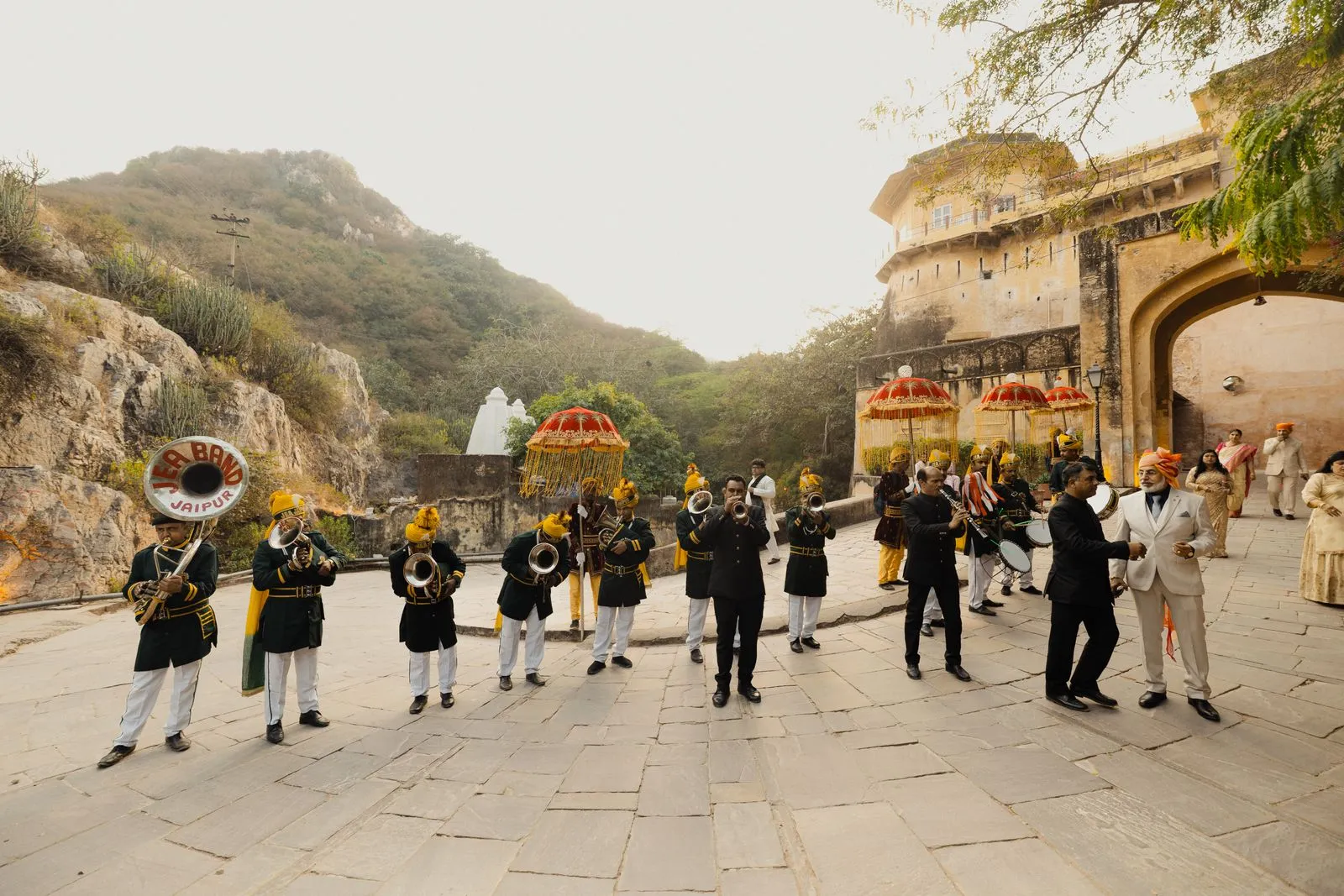
The baraat sets off with its own band, and the family dances through the streets to the venue.
4. Arrival and the welcome
At the gate, the bride's family greets the groom with garlands, tilak and aarti, often to the sound of the shehnai or the nadaswaram.
5. Milni
Then the milni, which means meeting: the relatives of both families meet, embrace, exchange garlands and share a meal before the wedding rituals begin. Our Hindu wedding rituals guide has what follows.
The baraat across India
- Telugu weddings: the edurukolu, when the bride's family receives the groom's party with nadaswaram music.
- Odia weddings: the barajatri. The groom is greeted with alati or tilak, and his feet are washed.
- Tamil weddings: the janavasam, when the groom is taken through the streets on the eve of the wedding.
- Tulu weddings in coastal Karnataka: the dibbana.
- Rajasthan: a baraat on camels is a traditional feature.
- Jammu: in Dogri, the baraat is the janjh.
How to plan the baraat
The start time
Work back from the muhurat. Your pandit gives the time the ceremony must begin; before it, the baraat has to arrive, finish the welcome and the milni, and sit down to dinner.
Example: say the muhurat for the pheras starts at 11:30 pm, and the jaimala, the milni and dinner take 2 hours. The baraat should reach the gate by 9:30 pm. If the route takes an hour with the dancing, it leaves by 8:30 pm, and the band is done before 10.
The route
Keep it short, and walk it once at the same hour as the baraat. A procession on a public road usually needs permission, so check with the local police station and the venue well before the day. Keep a generator truck or a horse carriage off roads too narrow for traffic to pass.
The music
Book the band or the dhol, and a DJ if you want one. Under the Noise Pollution (Regulation and Control) Rules, 2000, loudspeakers, bands and musical instruments can't be played between 10 pm and 6 am, except in closed premises for sound within them, and on the few festive nights a state allows until midnight. The Central Pollution Control Board's guidelines for marriage halls say no loudspeakers or bands after 10 pm. So plan for the band to finish before 10.
The ghodi or the car
Book the mare, the car or whatever your family keeps, and agree where it waits and when it must be ready.
Welcoming the baraat: the swagat
The bride's family receives the baraat at the gate: garlands, tilak and aarti for the groom, and music for the arrival. Then come the milni and a meal for the baraatis, who are your guests. Decide who stands at the gate, and have the garlands, the aarti thali and something to drink ready for a party that has just walked the route.
Planning the baraat with Brideshala
- Fix the date and the muhurat on our shubh vivah muhurat page, and with your pandit.
- Put the baraat's time on the card: our wedding card matter guide has a sample with "Baraat leaves".
- Ask the venue about the gate, the parking and its music cut-off, with our guide to choosing a wedding venue.
- For the rest of the night's music, see our sangeet ceremony guide.
When you're ready to ask vendors for rates, tap Get free quotes at the top of the page (on a phone, it's in the menu), and our team finds up to three who fit. They get back to you directly.
Leave on time, arrive before ten
Work the start time back from the muhurat, walk the route once, check the road with the police and the venue, and tell the band when to stop. Then let the baraat dance.
Questions families ask
What is the meaning of baraat?
The baraat is the groom's wedding procession, from the Sanskrit varayatra, the groom's procession. The groom, his family and friends travel to the wedding with music and dancing, and the bride's family receives them.
Is it baraat or barat?
Both. It's the same Hindi word spelt two ways in English, and dictionaries list both.
What happens at a baraat?
In order: the sehra bandi at the groom's home, the ghodi chadhna (or the car), the procession with the band and dancing, the welcome at the gate with garlands, tilak and aarti, and the milni between the two families.
How long does a baraat take?
It depends on the route and how often the procession stops to dance. Walk the route at the same hour and time it, add time for the dancing, and work the start back from the muhurat.
Who goes in the baraat?
The groom, his family and his friends, the baraatis. At the venue they're the bride's family's guests.
Until what time can a baraat band play?
Until 10 pm. The Noise Pollution Rules, 2000 bar loudspeakers, bands and musical instruments between 10 pm and 6 am outside closed premises, except on the few festive nights a state allows until midnight, and the CPCB's guidelines say no bands after 10 pm.
Do we need permission for a baraat on the road?
A procession on a public road usually needs permission. Check with the local police station and the venue well before the day.
Written by Sunny Kumar
Founder of Brideshala, Delhi. Sunny Kumar builds Brideshala, a directory of wedding venues and vendors across India, with every vendor's rate on the page.
All guides by Sunny →How we wrote this
Written from public rules and common wedding practice across India. Sources:
- Platts, A Dictionary of Urdu, Classical Hindi, and English (DSAL, University of Chicago): barāt, bārāt, barātī
- Wikipedia: Baraat (Varayatra; the band; the welcome with garlands, tilak and aarti; regional names), citing Das (1980), Falzon, Cosmopolitan Connections (2004), Matane and Ahuja (2004), Winthrop (1990) and Männer, Tulu-English Dictionary (1886)
- Myrvold, "Wedding Ceremonies in Punjab", Journal of Punjab Studies 11(2), 2004 (the procession, sehra, ghodi, sarbala, milni)
- Wikipedia: Telugu Hindu wedding (edurukolu); Odia Hindu wedding (barajatri)
- World Wisdom: janavasam
- Noise Pollution (Regulation and Control) Rules, 2000, rules 2(j) and 5 (text via the Uttarakhand Pollution Control Board)
- Central Pollution Control Board: guidelines for marriage halls and banquets (circulated 19 March 2020), Annexure II to its reply in NGT O.A. 285/2025 (no loudspeakers or bands after 10 pm; baraat processions)
No venue paid to be in this guide. Spotted a mistake? Tell us.
Found it useful? Send it to family.
WhatsAppMore guides
Kanyadaan Meaning and How the Ritual Is Done
Kanyadaan is the giving of a daughter in marriage. Here's what it means, how it's done step by step, who can do it, and how to time it.
Sangeet Ceremony: Meaning and How to Plan It
The sangeet runs on rehearsals, a running order and a 10 pm cut-off. Here's what it means, where it comes from and how to plan the night.
How to Choose a Marriage Hall, Lawn or Hotel for a Wedding
Photos and a per-plate rate don't show the real bill. Compare venues on what you'll actually pay, and get it in writing before the advance.