Somewhere in the wedding, the groom looks for his shoes and they're gone. His friends were meant to be guarding them. The bride's sisters are smiling, and the bargaining begins.
Joota chupai is a game, and both families are in on it. It goes well when everyone knows their part, the timing doesn't hold up the rituals, and the gift is agreed in good humour.
In this guide, we'll break down:
- what the joota chupai rasam is;
- when it's played, and who plays it;
- how it's played, step by step;
- how to keep the bargaining friendly;
- other Punjabi wedding games, from the ring game to the kalira.
It's for the bride's sisters and cousins planning the game, and for the groom's side, who have to guard the shoes.
On this page
What is joota chupai?
Joota chupai means "hiding the shoes". The bride's sisters and female cousins hide the groom's shoes, his friends try to stop them, and the sisters give the shoes back in return for a gift. It's a rasam, a custom, played at Punjabi weddings and, through films, far beyond them. In Punjab the groom wears juttis embroidered with golden thread on the day of the baraat.
A study of Punjabi wedding ceremonies describes it plainly: the sisters "make sure to give the groom a hard time and negotiate over monetary gifts in return for his shoes". As new sisters-in-law, the same study notes, they're entitled to make fun of the groom at the wedding: it's their part in the new relationship.
When joota chupai is played
The timing differs from family to family. The study of Punjabi weddings lists it among the customs after the wedding rites, before the vidaai.
Agree the moment with both sides and the pandit, so the game doesn't hold up the rituals or the muhurat. Our Hindu wedding rituals guide has the order of the day.
How joota chupai is played, step by step
1. The bride's side makes a plan
The sisters and cousins decide who takes the shoes, when, and where they'll hide them. A hiding place that the groom's friends won't search is half the game.
2. The groom's side guards the shoes
The groom's friends and brothers keep watch over the shoes. Their job is to make the sisters work for them.
3. The shoes go missing
When the shoes come off, the sisters take their chance, and the shoes vanish.
4. The bargaining
When the groom wants his shoes back, the sisters name their price and the groom's side bargains. This is the part everyone watches.
5. The shoes come back
The two sides agree, the groom gives the gift, and the shoes are returned.
Keeping the bargaining friendly
The game works because it's played for fun. The gift is for the two families to agree, not for anyone to win. Talk about it beforehand, and let the elders settle it if the bargaining runs on. When it doesn't stay friendly, it can sour the day: in 2025, a joota chupai argument at a wedding in Bijnor, Uttar Pradesh, turned into a fight between the two sides.
Joota chupai on screen
The 1994 film Hum Aapke Hain Koun..! made the game famous with its song "Joote Do, Paise Lo", sung by Lata Mangeshkar and S. P. Balasubrahmanyam. Writing on weddings in Hindi films, the film scholar Rachel Dwyer notes that rituals seen in films, such as hiding the shoes, are becoming pan-Indian, while others stay with their communities.
Punjabi wedding games
Joota chupai isn't the only game in a Punjabi wedding. These come from the same study of Punjabi wedding ceremonies:
- The ring game. On the evening the couple reach the groom's home, a pot is filled with milk and water and a ring or a coin is dropped in. The couple search for it, and as the saying goes, whoever finds it will lead in the marriage.
- Untying the thread. The same evening, the couple try to untie the threads tied on their wrists before the wedding. The bride may use both hands and the groom only one, and everyone teases him if he can't.
- The kalira. The bride's bangles carry kaliras, given by her mother's sister. A saying goes that the unmarried girl a kalira falls on will be the next to marry.
- Holding the reins. Before the baraat leaves, the groom's sister feeds the mare and holds its reins until she's given a gift. Our baraat guide has the rest of the procession.
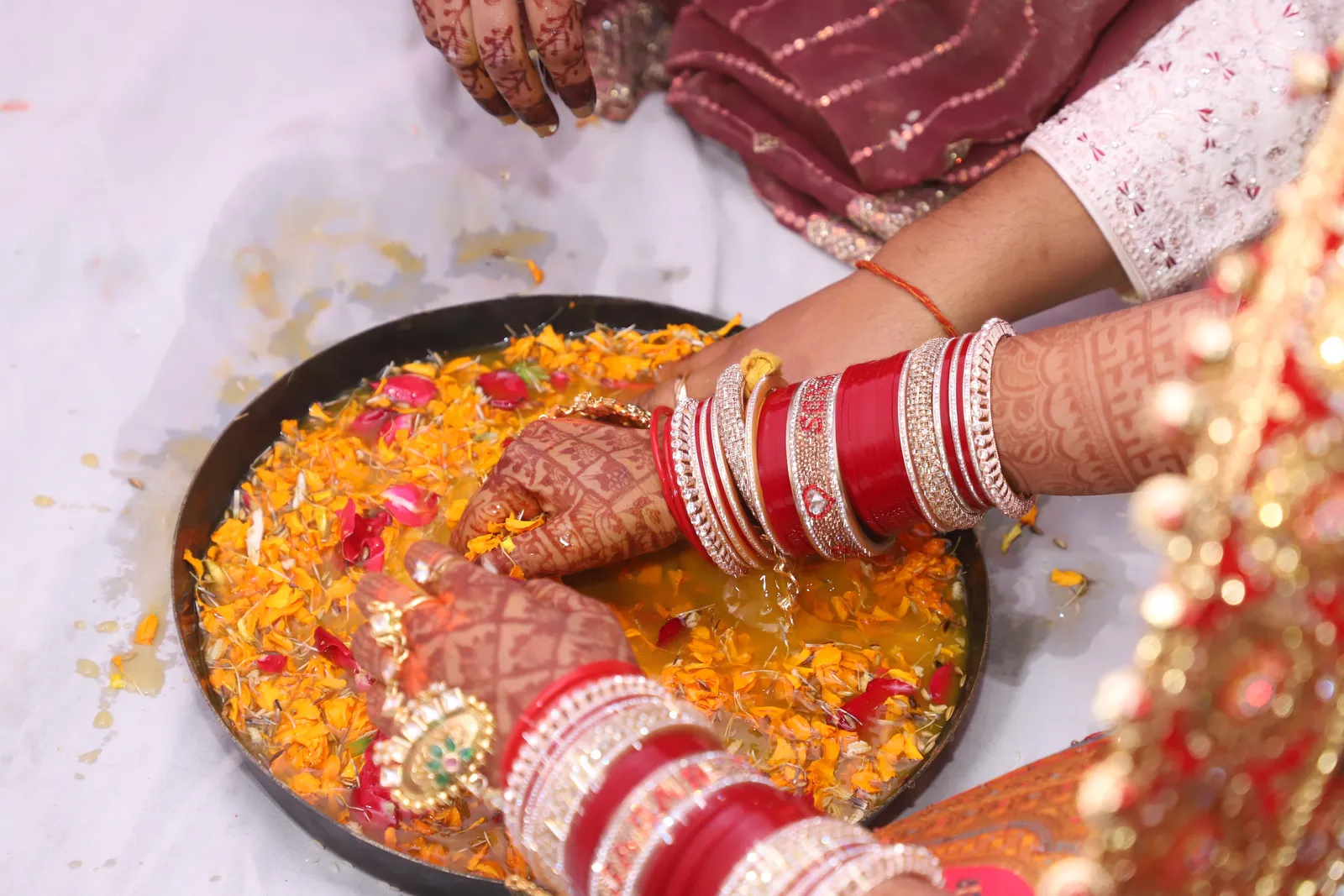 Photo: AmanAgrahari01, CC BY-SA 4.0, via Wikimedia Commons
Most of these games, the study suggests, help the new couple get to know each other.
Planning the games with Brideshala
- Fit the games into the day with our Hindu wedding rituals guide, and see what comes just before the pheras in our kanyadaan guide.
- Plan the arrival, and the sister's gift at the mare, with our baraat guide.
- For the music and the dancing the night before, see our sangeet ceremony guide.
Play it, then give the shoes back
Pick the moment with both sides, guard the shoes well, bargain with a smile, and agree the gift before tempers rise. The groom should walk out of his wedding in his own shoes.
Questions families ask
What is joota chupai?
A wedding game: the bride's sisters and female cousins hide the groom's shoes, his friends try to guard them, and the shoes are returned in exchange for a gift that the two sides agree.
When is joota chupai done?
It differs by family. A study of Punjabi weddings places it after the wedding rites, before the vidaai. Agree the moment with both sides so it doesn't hold up the muhurat.
Who hides the groom's shoes?
The bride's sisters and female cousins, his new sisters-in-law. The groom's friends and brothers guard the shoes.
What does the groom give in joota chupai?
A gift the two sides agree on, in good humour. What and how much is for the families to settle; the game is played for fun, not to win.
Is joota chupai only a Punjabi custom?
It's a custom of Punjabi weddings, and Hindi films, Hum Aapke Hain Koun..! (1994) among them, have helped carry it to weddings well beyond Punjab.
What is the ring game at a wedding?
After the wedding, at the groom's home, a ring or coin is dropped into a pot of milk and water, and the couple search for it. The saying goes that whoever finds it will lead in the marriage.
Written by Sunny Kumar
Founder of Brideshala, Delhi. Sunny Kumar builds Brideshala, a directory of wedding venues and vendors across India, with every vendor's rate on the page.
All guides by Sunny →How we wrote this
Written from public rules and common wedding practice across India. Sources:
- Kristina Myrvold, "Wedding Ceremonies in Punjab", Journal of Punjab Studies 11(2), 2004, pp. 155–170: the shoe game, the groom's juttis, the ring game, untying the thread, the kalira, the reins
- Wikipedia: Punjabi wedding traditions (joota chupai, "hiding the shoes")
- Brides Today (India Today group), Sakshi Deshmukh, 24 May 2024: the groom's side guards the shoes; played for fun
- Aaj Tak, 7 April 2025: a joota chupai dispute at a wedding in Bijnor, Uttar Pradesh
- Wikipedia: Hum Aapke Hain Koun..! (soundtrack): "Joote Do, Paise Lo", Lata Mangeshkar and S. P. Balasubrahmanyam
- Rachel Dwyer, "A Knot in the Plot", Open magazine, 29 March 2024: the shoe-stealing song; rituals from films becoming pan-Indian
No venue paid to be in this guide. Spotted a mistake? Tell us.
Found it useful? Send it to family.
WhatsAppMore guides
Kanyadaan Meaning and How the Ritual Is Done
Kanyadaan is the giving of a daughter in marriage. Here's what it means, how it's done step by step, who can do it, and how to time it.
Hindu Wedding Rituals Step by Step, in Order
A Hindu wedding is a string of rituals, each with its own people, things and time. Here they are in order, as a family plans them.
Haldi Ceremony: What It Is and How It's Done
Haldi is the yellow, happy start to a wedding. Here's what it means, what goes in the paste, and how to hold it without stained floors or itchy skin.